ONE CHANCE TO DO IT RIGHT!

ONE CHANCE TO DO IT RIGHT!

The resilient golf course construction and renovation industry is on the move here in Southeast Asia once more. With the golfing populations continuing to expand in neighbouring countries, strongly supported by massive tourism growth, golf courses are finding it necessary to upgrade and improve, and indeed to build new facilities, to keep up with the competition for revenues from tourists, memberships and leisure golfers.

From past experiences, both successes and failures, it would be most prudent for owners, membership committees and developers not to forget the basic ingredients necessary to bring a successful project to fruition. Firstly, the feasibility study, whether for a new project or renovation, which forms the foundation upon which one can operate from beginning to end. Once all aspects of the potential facility have been studied thoroughly by professionals, then only minor changes, which themselves do not incur major budget overruns, need be made to fine-tune the project.

The next stage is obviously the design process. The more experienced and qualified your architect is, the more you can depend on the “frame of reference” from which they draw. For example, someone who has designed twenty projects with varying conditions, can pull ideas and concepts from their memory and experience that you can use to help avoid costly mistakes. By contrast, a newcomer to the business will have a very steep learning curve and will depend on your money and resources to develop his experience.

The value of quality construction is what will determine the longevity and ultimate success of your project, as you only have one chance to build it right! Golf, being a relatively youthful industry here in Asia , has only a few dedicated, qualified and highly experienced golf course contractors, designers and superintendents. Choose yours based upon their work in the Region.

Of all the criteria that form the construction or renovation of a golf course, none is more important than the surface that the golfers will play on, namely the mature turfgrass. No matter how creative, imaginative or challenging the golf course’s features might be, if it is not covered with a dense, beautiful and high quality turfgrass, it will not be appreciated by average golfers. Establishing and maturing a good stand of turfgrass is a prime responsibility of a golf course superintendent. This task is not a simple one and requires an understanding and working experience of the whole process of construction or renovation. It is vital that this professional be part of the process throughout.

In summary, to the untrained eye, golf course design, construction, renovation and maintenance may seem unstructured and easily be done by people who themselves play, or who are around, the game. In reality, however, it is a highly organized effort best left to professionals who will ensure the long term protection of your golf club, the investment of its owners and members, as you only have one chance to do it right!

TRADITION OF EXCELLENCE IN KEEPING THE GREEN (Part Three)

TRADITION OF EXCELLENCE IN KEEPING THE GREEN (Part Three)

Golf Courses throughout Asia share common ground when it comes to maintaining greens – we are all fighting Mother Nature’s fury in the monsoon season, with the goal of keeping fine quality turf alive and playable. Turf decline starts to occur during the intensive rains and extremely low light levels. Then, and often for days on end, it is nearly impossible to grow healthy greens grass and still keep putting surfaces playable for our members and the golfing public.

Now that we have completed the greens renovation programme at Thai Country Club, our focus is on developing a long term maintenance programme that can be adapted to suit these extreme growing conditions and weather patterns in this region

It is of utmost importance to understand that the greens renovation programme and planting of new turf is not the end of the process, and that it is how the greens are managed and maintained after the renovation process that will guarantee success.

The soils and sands in Asia are usually deficient in important nutrients needed for suitable growth of greens turfgrass. The only way to tell exactly what your soils and sands have to offer is through extensive soil tests that are sent to reputable laboratories where accurate results can be determined. The vast prior experience in this region proves that most soils are deficient in Calcium. During seasonal rains, this nutrient usually washes through the soils rapidly requiring additional applications to supplement the plants’ needs in times of stress. This was, in fact, exactly what we encountered at Thai Country Club.

After conducting these tests and formulating fertility programmes, we reviewed and adjusted our mowing heights and notified the membership that greens speeds may be slower during the monsoon season as compared to the drier, cooler seasons. Normally the height of cut may need to be raised even on the ultradwarf Bermuda grasses. This raised height of cut will allow for more leaf tissue to absorb the sunlight in order for the plant to make its own food through the process of photosynthesis.

Since the raised mowing heights have reduced green speeds, a benchmark has been set and presented to the committee, management and members for their information on what the ideal green speed should be during different times of the year and in growing seasons. This type of educational communication not only benefits the health of the greens in the long term, but it also assists the membership and management to understand what it takes to protect their greens, and hence their investment, during rough weather.

I sincerely hope that these articles about our experience at Thai Country Club will be useful to you the reader, as our esteemed golfing public, and that some of the data can be applied or better understood at your facility. If so, we as Golf Course Superintendents and ‘keepers of the green’ can more easily ensure that the putting surfaces at your club will be ready and in prime condition for upcoming tournaments and during the cooler weather that forms the ideal golfing season in Asia.

TRADITION OF EXCELLENCE IN KEEPING THE GREEN (Part Two)

TRADITION OF EXCELLENCE IN KEEPING THE GREEN (Part Two)

International golf tournaments and television viewing by millions of golfers worldwide has certainly raised the bar in terms of what the average golfer and private club members expect for putting green quality. The double-edged sword is that they now demand speed and good-looking turf colour. What they fail to realize is that most of the courses shown on TV are meticulously maintained for months in advance and usually have large budgets at hand to have the greens peak for the tournament week.

The most important decision in building and/or renovating greens in this modern era is of course which turf to select as the final playing surface. When looking at greens grass that will satisfy today’s members, we only have a few options to choose from. Here in the tropics, we know that bent grasses will not succeed, so the only viable options are the Bermuda grasses, Zoysia grasses or the latest Paspalum grasses.

On Thai Country Club’s greens, the only logical options were Bermuda grass and Paspalum. The latter being relatively new to the region and mostly successful on sites with poor water or soil quality, it became a close second to the newest variety of bermudagrass called TifEagle. Fortunately, this patented variety of TifEagle Bermuda has a six year successful track record in this region and has performed well year perennially. The greens speeds that have been achieved with TifEagle for important regional tournaments have been in excess of 12 feet, which was during the Volvo Masters of Asia at Bangkok Golf club in 2003, and over 11 feet for the Johnnie Walker Classic at Alpine Golf & Sports Club in 2000. During tournament time, you can also retain great color with minimal effort. This turf was made to be mowed low and stays tight and smooth for regular maintenance even before and after tournaments. The maintenance practices are not as difficult to perform as might be expected.

Since we have fully completed construction and renovation work on the greens at Thai Country Club, we are now in the most important phase which is maintenance preparation for our heavy rain season in Bangkok. Subsequently, when the cool northeasterly winds blow in during November we start our fine tuning programme for health, colour and green speeds for the upcoming golf season and the prestigious Volvo Masters of Asia tournament in early December.

With a little luck, a lot of skill and good weather, all will be in good order for television viewers, professional golfers and our important members for their golfing season. When keeping the tradition with the most sensitive area of golf course greens, it all breaks down to having good working KNOWLEDGE of what is being done; having CONTROL over your projects; and finally taking the RESPONSIBILITY to make it all go right.

TRADITION OF EXCELLENCE IN KEEPING THE GREEN (Part One)

TRADITION OF EXCELLENCE IN KEEPING THE GREEN (Part One)

As those of us in the golf course maintenance business are all well aware of, our single most important responsibility is keeping golf course greens in excellent condition. Members will be more forgiving on all other details of golf course presentation if you provide them with great putting surfaces.

In keeping with this tradition, the management and membership at Thai Country Club took the long-term view over the short-term one when deciding to renovate their greens. We commenced the programme by re-grassing 5 greens in the last quarter of 2004 and, having met with considerable success, we then committed to complete the remainder of the greens between April and August 2005. Since we have Seashore Paspalum fairways, we were able to provide temporary greens of a high quality, cut at 4mm and averaging 8 feet 6 inches in speed readings throughout the period.

As those of us in the golf course maintenance business are all well aware of, our single most important responsibility is keeping golf course greens in excellent condition. Members will be more forgiving on all other details of golf course presentation if you provide them with great putting surfaces.

In keeping with this tradition, the management and membership at Thai Country Club took the long-term view over the short-term one when deciding to renovate their greens. We commenced the programme by re-grassing 5 greens in the last quarter of 2004 and, having met with considerable success, we then committed to complete the remainder of the greens between April and August 2005. Since we have Seashore Paspalum fairways, we were able to provide temporary greens of a high quality, cut at 4mm and averaging 8 feet 6 inches in speed readings throughout the period.

Through monitoring the quality of the greens very closely over the years, we have found that they would deteriorate appreciably during the monsoon season from August to October in Thailand. By contrast, the dry season – from November to July – really presented fewer challenges as we could control the water input and disease pressure. Once greens are under stress due to low light conditions and torrential rains, they are difficult to keep healthy and playable at the same time, which is ultimately what is required by our membership.

We have fully completed the programme ahead of the next monsoon season, and remain confident that the work done will prove to be prudent both in withstanding the imminent heavy rains, and in providing stellar conditions for the year-end golf season. Furthermore, our programme affords us the ample time of three months to implement the finishing touches to the greens in time for the prestigious Volvo Masters of Asia, the Asian Tour’s season-ending championship, which the Club will be hosting from 8th-11th December. This flagship event will surely confirm to the golfing community throughout the Region that international standard greens maintenance is possible if you have the right technology and a Club that is committed to providing excellence in conditioning.

SETTING GOLF COURSE POLICY GUIDELINES & STANDARDS

SETTING GOLF COURSE POLICY GUIDELINES & STANDARDS

Before you can satisfy expectations of members and guests at your golf coursed facility, it would be prudent to determine their exact nature so that you can accurately identify which goal or purpose you are working towards. Setting written standards with the committee and/or owner of a golf course goes a long way to creating reality and agreement on where your priorities lie, and only then can you focus your energies to achieve some mutual understanding and perceived benefit for the Club.

Another purpose for implementing maintenance standards is to provide continuity in the goals of the committee and/or owner and guidelines from year to year. These policy standards should be written down in a formal manual, which can be adjusted after each year’s performance to correct and/or change components that were either not successful or not accepted.

Areas that can be standardized include:

Greens: The benchmark green speeds should be set in accordance with the season and or weather conditions. For example, during the monsoon seasons you would want to raise the height of cut to protect the health of the turf. If the membership supported this policy, they would understand that, in order to provide great greens for the golf season, they would have to endure slower green speeds during the monsoon season, when it is the most stressful time to grow turf.

Also, coring and renovation timelines and procedures could be spelled out and planned annually according to set policy. Members would then know what to expect and schedule visits with their VIP guests accordingly.

Tees: Guidelines should be set for tee leveling and uniformity, along with listing the mowing heights, divot repair procedures and marker rotations.

Fairways: Fairway width can be standardized, and mowing heights and cultural practices can be included to set objectives for turf density, fairway firmness and uniformity.

Bunkers: This most volatile area can be discussed and a general agreement can be detailed to include sand firmness and frequency of hand-raking versus machine-raking, and edging schedules of bunkers can be set to ensure consistency.

Roughs: Heights of cut, mowing frequencies and density of the turf can be decided upon and adapted to members’ preferences depending on the age and/or skill level of your members and guests.

Landscaping and Tree Maintenance: Since these areas also require continual maintenance and care, it can be determined how much the Club is willing to invest in them in the long term. All too often, new Committees add more trees and flowerbeds without consideration for future financial implications. Furthermore, since trees have a negative impact on the eventual quality of the turf, the golf course management should carefully identify and recommend which types of trees and/or shrubbery to plant.

In summary, these standards can be plain and simple, and can be professionally developed by an external consulting agency in coordination with the committee and management.

Other successful businesses have standard policies and procedures that help them achieve customer satisfaction. Likewise, golf course facilities should also have a written manual for daily and long-term operations. When performed accurately, this will bring management and membership to a better understanding of what is expected, needed and wanted for our golfing public.

QUALITY GOLF DRIVES TO THE FORE IN ASIA ECONOMIC OVERVIEW

QUALITY GOLF DRIVES TO THE FORE IN ASIA ECONOMIC OVERVIEW

Economic overview

The golf industry in Asia is now starting to show positive signs of recovering from the economic crisis that beset the region in 1997 , albeit with rightful cautio n . For many of the expensive courses, built by marquee name designers just prior to the economic crisis, plunging currency valuations and significant debt burdens mean their futures are still in doubt. Nonetheless, the popularity of the game continues to grow rapidly across the region .

In 1998, excluding Japan, there were 1,217 golf courses serving a population of 3.8 million golfers. By 2004, the number has increased to 1,458 golf courses serving a population that has grown at an average annual rate of 12% to its present level of 8.3 million golfers.? And this is in spite of the predomination of member or resort courses that are largely inaccessible to the general public.

? Figures are provided by Asian Golf Monthly Magazine

Asia’s largest golf populations, outside of Japan, reside in Korea, Taiwan, Malaysia and Thailand. China too is emerging as a prolific growth market. A few years ago, only a handful of courses existed there. Today, the number has soared to 180. The golf industry is set to explode over the coming two decades as public pay and play golf courses continue to make golf ever more affordable to citizens of average income . As this happens, golf instruction will also blossom, giving new golfer s necessary insight and incentive.

Our Background

Quality Golf was founded in Thailand in 1994 , himself a Certified Golf Course Superintendent with more than 35 years of experience in the golf industry. During his career, Tony has established a stellar reputation worldwide, consistently leading the industry with innovative course maintenance practices and is widely regarded as the one of the most prominent Superintendents in Asia .

He invented the ‘World Class Maintenance Success System’, a system that produces a detailed rating for Turf Health, Maintenance and Playability of Tees, Fairways, Roughs and Greens as well as Consistency of Bunkers and Landscape Appearance, and also provides extensive training for Golf Course Maintenance Staff. This pioneering System is presented in a comprehensive (and indeed comprehensible!) report format to Golf Club Management, enabling key areas for improvement to be clearly identified.

Over the past 10 years, Quality Golf has established a reputation as a n Asian golf course constructio n, maintenance and management enterprise of the highest calibre. Our success has been founded upon the principles of combining modern technology with local expertise, of sound financial management, employee development, delivering world class customer service and a firm commitment to enhancing the quality of life of the communities in which we work .

Our philosophy is focused on the belief that every project, however large or small, is a reflection of who we are. Consequently, we will not undertake any project where we do not truly believe that we can provide results that exceed our clients’ expectations.

Our services encompass Feasibility Studies, Course Design , T urn-key C ourse Construction , Course R emodeling & A lterations , Construction Management , Subcontractor Assessment and Evaluation , Course Landscaping, Course Maintenance, Tournament Preparation, Course Management and Marketing.

Furthermore, we also have official licences to distribute an extensive range of high quality, course-related products, including Lebanon Turf Products; Manderley Turf Grasses (TifEagle and SeaIsle 2000); Aqua-Aid turf enhancement products (such as AquaMaxx, Proportioner, Carbo-Aid, Aquifer); ADS advanced drainage systems; Signature irrigation systems; and a host of maintenance products from Parkway Research Inc and accessories from Precision USA, all of which we supply to a growing number of golf courses throughout Thailand and across the Region.

Thailand

Our first major project was working with Dennis Griffiths on the re-design and construction of the prestigious Thai Country Club in Bangkok in 1994, where we have subsequently implemented and managed a highly sophisticated maintenance programme. Thai Country Club has consistently set the highest industry standard in course presentation, and indeed in customer service, that other golf course owners in the region aspire to replicate

The signature 6 th hole at Thai Country Club, measuring 218 yards from the black tees, has been voted the “Best Par 3 in Asia ” by readers of Asian Golf Monthly magazine every year since 2000.

During our 10-year relationship with the Club, we have also prepared the course to host several significant international tournaments, namely the Asian Honda Classic in 1997, which was won by Tiger Woods, and the Johnnie Walker Super Tour in 1998 which featured several golfing superstars including Vijay Singh and Ernie Els, the latter commenting that “the course was in the best condition of any I have played in Asia”.

We are immensely proud to report that the Club has this month been recognized once again as ‘The Best Course in Thailand’, the 3 rd time in the past 4 years that it has been awarded this accolade by the readers of Asian Golf Monthly, the region’s leading industry publication.

Other clients in Thailand have included the exclusive Rajpruek Golf Club in Bangkok, where we undertook a course renovation and placed Superintendent, Robert Barnes, who has overseen our maintenance programme for the past 4 years, and the Robert Trent Jones Jnr-designed Santiburi ChiangRai course in the northern province of ChiangRai, which involved Superintendent placement, staff maintenance training and tournament preparation for the Singha Masters, one of the most prominent tournaments on the domestic PGA schedule.

In June 1999, we were selected by Alpine Golf & Sports Club to prepare the Ron Garl-designed course to host the Johnnie Walker Classic in 2000, a professional tournament jointly sanctioned by the PGA European Tour, Asian PGA Tour and Australasian Tour.

In October 2001, we were appointed to design and build the first golf course on the exotic island of Koh Samui, called Santiburi Samui Country Club. The Island itself is located in the Gulf of Thailand, some 700 kms south of Bangkok and 20 kms off the coast of Surat Thani Province. It is Thailand ‘s third largest island, after Phuket and Koh Chang.

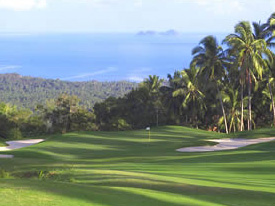
Golf course designer Pirapon Namatra, himself arguably one of the Region’s most exciting young talents, devised a 6,932 yard routing that stretched east-west adjacent to the island’s north coast, blending harmoniously with the natural environment and encompassing elevation ranging between 30-190 metres above sea level. An 18-hole layout was literally carved from the hinterland of granite and limestone hills. Narrow fairways, lined with coconut palms and sharp drop-offs, coupled with large, undulating green complexes make for an extremely challenging layout. This is, however, counter-balanced by the aesthetic nature of the course, with truly spectacular panoramic vistas of the turquoise-coloured ocean and golden beaches from 14 holes.

The Gulf of Thailand provides an idyllic backdrop for the 453 yard par-4 16 th hole of Santiburi Samui Country Club.

Tifeagle Grass has been used on the Greens, Seashore Paspalum Grass on the Fairways, and Bahia Grass for the Roughs. Numerous natural Waterfalls and Creeks run through the 450 Rai (72 Hectare) site, adding to its lushness and beauty.

The project was completed in 24 months and the course was opened for play in January 2004. We are confident that Santiburi Samui Country Club is destined for a great future. As word spreads, it will soon become a highly desirable new retreat for keen golfers from Thailand, across the region and internationally, providing a welcome boost in revenues generated by the island’s economy from its existing 870,000 annual visitors.

Tifeagle Grass has been used on the Greens, Seashore Paspalum Grass on the Fairways, and Bahia Grass for the Roughs. Numerous natural Waterfa

Indonesia

Since 2001, we have provided Ria Bintan Golf Course with maintenance consultancy services, assisting the Club to restore its international standards and 5-star reputation.

alls and Creeks run through the 450 Rai (72 Hectare) site, adding to its lushness and beauty.

The project was completed in 24 months and the course was opened for play in January 2004. We are confident that Santiburi Samui Country Club is destined for a great future. As word spreads, it will soon become a highly desirable new retreat for keen golfers from Thailand, across the region and internationally, providing a welcome boost in revenues generated by the island’s economy from its existing 870,000 annual visitors.

Hong Kong

In July 2003, Quality Golf was appointed by Hong Kong Golf Club to upgrade their maintenance programme to international standards initially in preparation for the hosting in early December of the Omega Hong Kong Open, a professional tournament jointly sanctioned by the PGA European Tour and the Asian PGA Tour. The result was a resounding success, with most members and competitors agreeing that the course was in the best condition it had been in for over 10 years. 2003 Champion, Padraig Harrington, praised the conditioning of the course in his speech given at the awards ceremony.

The majestic view from behind the 18 th green on The Eden Course at Hong Kong Golf Club, one of three courses at this 115-year old, world-renowned Club.

The Hong Kong Golf Club, established in 1889, is undoubtedly one of the most distinguished and respected Clubs both in the Region and also worldwide. Steeped in history and tradition , each of the three 18-hole courses, the New, Eden and Old, possesses its own distinct character.

Further to the success of The Hong Kong Open, our relationship has expanded and we have now developed a comprehensive plan to re-establish the Club as one of the leading facilities in Asia . We have placed two highly experienced Superintendents at the Club, Chris Norton and Ryan McFarlin, who will bring our plan to fruition. We are currently moving forward with the implementation of sound turf management practices on all of the golf courses. A considerable beautification program me is b eing developed to significantly improve the landscape and an in-depth training programme is being provided to all 90 members of the Club’s maintenance staff which will greatly enhance the quality and efficiency of their work.

We are very proud to report that the Club has agreed to extend our relationship until mid-2006, providing a very solid platform for Quality Golf to grow in South China.

Conclusion

With the region’s economies making a genuine resurgence, Quality Golf is well positioned to deliver high calibre solutions to golf course owners and investors who share our vision of creating an outstanding and memorable experience for their members and guests, and who realize the true potential of professionally maintained, managed and marketed facilities to yield tangible, extensive and lasting revenue streams.

Our philosophy has enabled us to develop strong relationships with a growing number of leading golf courses in the Region, whom we are very proud to serve, and we are confident that it constitutes a firm platform for continued success both for our clients and ourselves in the future.